F1, Ground Floor, Sector 3, Noida
 +91 8882471048
 info@timberandply.com
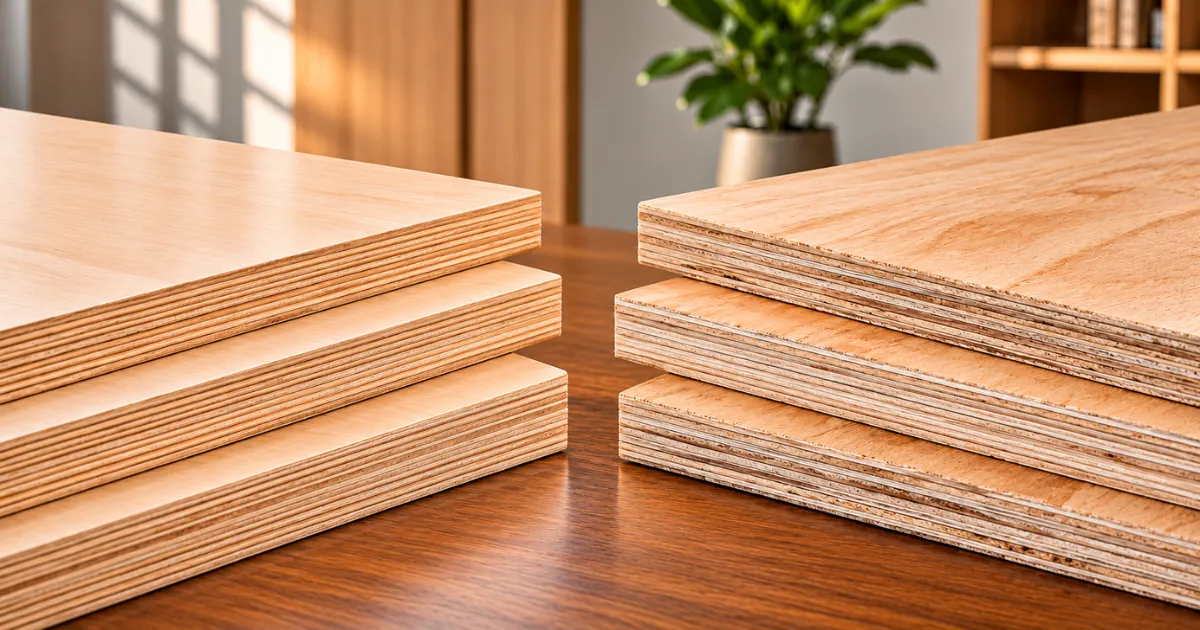
Plywood selection plays an important role in furniture manufacturing, especially when accuracy, uniform dimensions and surface quality are important. A small difference in panel thickness may seem insignificant, but it can create problems during laminate application, edge banding, CNC cutting and modular furniture assembly.
This is why many furniture manufacturers and interior contractors consider calibrated plywood for projects that require consistent panel dimensions. Commercial plywood, on the other hand, is widely used for general furniture and interior applications where the required level of dimensional precision may differ.
Understanding calibrated plywood vs commercial plywood requires looking beyond the product name. The actual difference lies in the manufacturing and finishing process, particularly how the plywood is processed to achieve uniform thickness and surface consistency.
This guide explains what calibrated plywood is, how it differs from regular commercial plywood and what manufacturers should check before selecting either option.
What Is Calibrated Plywood?
Calibrated plywood is plywood that undergoes an additional precision sanding or machining process to achieve more consistent thickness across its surface.
During normal plywood manufacturing, multiple wood veneers are bonded under controlled heat and pressure. Although this process produces a strong panel, minor thickness variations can occur due to differences in veneer thickness, adhesive distribution, pressing conditions and material characteristics.
Calibration helps correct these variations by removing small amounts of material from the plywood surface using specialised sanding equipment.
The objective is to achieve:
- More uniform thickness across the sheet.
- Better dimensional consistency between panels.
- A more even surface for laminates and veneers.
- Improved accuracy during furniture fabrication.
- More predictable results during machine processing.
Calibrated plywood meaning: It refers to plywood processed to achieve a specified level of thickness uniformity. Calibration is a manufacturing process, not a separate plywood grade or moisture-resistance classification.
How Is Calibrated Plywood Different from Commercial Plywood?
Commercial plywood is generally manufactured for furniture, interior work and other general-purpose applications. Its thickness and surface characteristics depend on the manufacturing process, veneer quality, pressing conditions and finishing operations.
Calibrated plywood receives an additional thickness-correction process after pressing. This makes it more suitable for applications where dimensional consistency is important.
|
Comparison factor |
Calibrated Plywood |
Commercial Plywood |
|
Manufacturing |
Includes precision calibration |
Standard plywood manufacturing |
|
Thickness |
Controlled to a specified tolerance |
May have greater thickness variation |
|
Surface consistency |
More uniform after calibration |
Depends on sanding and manufacturing quality |
|
Laminate application |
Helps achieve consistent panel preparation |
May require additional preparation |
|
Edge banding |
Supports more consistent edge finishing |
Results depend on actual panel dimensions |
|
Modular furniture |
Suitable for precision fabrication |
Suitable depending on project requirements |
|
Customisation |
Available in different plywood grades |
Available in different plywood grades |
One important clarification is that commercial plywood is not automatically uncalibrated. A commercial plywood product can also undergo calibration. The distinction is between the product category and the additional processing step.
Why Plywood Thickness Variation Matters in Furniture Manufacturing
Plywood thickness variation can create practical problems when multiple panels need to fit together accurately.
Consider a modular kitchen where several cabinet panels are manufactured using the same nominal thickness. If the actual thickness varies between sheets, manufacturers may need to make adjustments during cutting, joining and finishing.
Some common problems include:
- Uneven edge banding: Different panel thicknesses can affect edge band selection and finishing, creating inconsistent edges.
- Cabinet alignment issues: Variations in panel dimensions can affect the alignment of cabinet components, shelves and shutters.
- Laminate application challenges: Uneven surfaces may require additional preparation before laminate or veneer application.
- Hardware fitting difficulties: Inconsistent panel dimensions can affect the fitting of hinges, screws and other furniture hardware.
- Production inconsistencies: Manufacturers using automated machinery may need additional adjustments when incoming sheets do not meet their required dimensions.
Consistent plywood thickness helps reduce these issues, particularly in repetitive furniture production.
Understanding Plywood Thickness Tolerance
Plywood thickness tolerance refers to the permissible difference between the declared thickness and the actual measured thickness of a sheet.
For example, a plywood sheet sold as 18 mm may not measure exactly 18 mm at every point. The acceptable variation depends on the applicable product standard and the manufacturer's declared specifications.
Under IS 303:2024, the dimensional tolerance for general-purpose plywood is:
|
Thickness |
BIS thickness tolerance |
|
Below 6 mm |
±10% |
|
6 mm and above |
±5% |
These are standard dimensional tolerances, not the tighter calibration tolerances that a manufacturer may separately specify for calibrated products.
Plywood+1
For precision furniture manufacturing, buyers should request a specific calibration tolerance in writing. Do not assume that every product marketed as calibrated plywood automatically meets ±0.2 mm or ±0.3 mm.
The supplier should clearly mention the target thickness, permitted variation and measurement method in its technical specification.
How Calibrated Plywood Improves Surface Finish and Smoothness
Plywood surface finish and smoothness are important when the finished furniture will receive laminate, veneer, paint or other decorative treatments.
Calibration helps create a more consistent panel thickness, but it is important to understand that thickness uniformity and surface smoothness are not exactly the same thing.
A calibrated sheet may have uniform thickness but still require suitable surface preparation before decorative finishing.
Its practical advantages include:
- More consistent preparation before laminate application.
- Better control over panel dimensions.
- Reduced thickness-related finishing adjustments.
- More predictable edge banding results.
- Improved consistency across repeated furniture components.
Manufacturers should also inspect the face veneers for patches, sanding marks, cracks and other visible defects. Calibration cannot correct poor veneer quality or internal core defects.
Benefits of Calibrated Plywood for Modular Furniture Manufacturing
Modular furniture manufacturing requires multiple panels to fit together according to predefined measurements. Even small dimensional differences can affect the final assembly.
The benefits of calibrated plywood become particularly relevant in the following applications:
Modular kitchens: Uniform panel thickness helps maintain consistent cabinet dimensions and supports accurate hardware installation.
Wardrobes: Consistent panels help manufacturers achieve better alignment between shelves, partitions and shutters.
Office furniture: Repeated desk and storage components benefit from predictable panel dimensions.
CNC furniture production: More consistent material thickness helps reduce machine setup adjustments and supports repeatable machining.
Laminate furniture: Uniform thickness makes it easier to maintain consistent panel preparation and edge finishing.
These advantages depend on the actual calibration tolerance, plywood construction, machine settings and fabrication quality.
How to Check Calibrated Plywood Before Buying
A product label alone is not sufficient to establish calibration quality. Furniture manufacturers should inspect the material and verify its specifications before approving bulk procurement.
Follow these practical checks:
- Measure multiple points: Use a calibrated digital thickness gauge or suitable micrometer to measure the sheet at several positions.
- Check both surfaces: Look for uneven sanding, surface waves and visible defects.
- Compare multiple sheets: Check thickness consistency across different sheets from the same batch.
- Inspect the edges: Look for gaps, overlaps and irregularities in the plywood core.
- Request technical specifications: Ask the manufacturer to declare the nominal thickness and calibration tolerance.
- Check the plywood grade: Verify whether the product meets the required MR, BWR or BWP specification under the applicable standard.
A simple measurement at one corner is not enough to establish thickness uniformity across an entire sheet.
Conclusion
The choice between calibrated plywood vs commercial plywood depends on the manufacturing requirements and the level of dimensional consistency needed for the finished product.
Commercial plywood can be suitable for general furniture and interior applications, while calibrated plywood offers an additional level of thickness control that benefits modular furniture, CNC processing, cabinetry and precision finishing.
Shree Ram Timbers and Plywood recognises the importance of selecting plywood according to actual project requirements. Manufacturers should evaluate thickness tolerance, core construction, surface quality and applicable plywood grades before finalising their material selection.
The right choice is not simply about buying calibrated or commercial plywood. It is about selecting a product that delivers the required consistency, quality and performance throughout the manufacturing process.